Specifications
800G OSFP Transceivers for High-Performance Networks
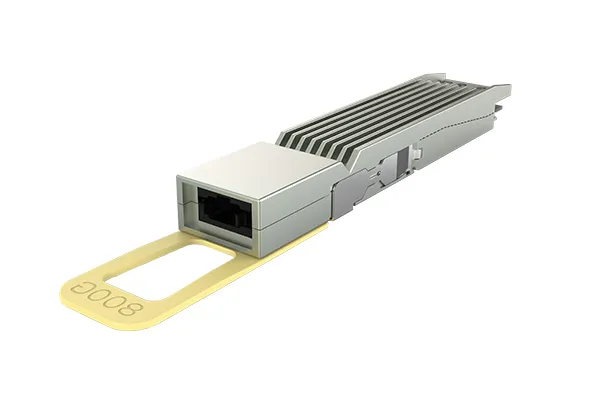
Reliable, high-density 800G optical connectivity designed for modern data centers, cloud networks, AI and machine-learning fabrics, high-performance computing environments, and high-capacity switch-to-switch interconnects. The E.C.I. NETWORKS OSFP-800 delivers 800 Gigabit Ethernet connectivity through eight parallel 100G PAM4 optical lanes operating in the 850 nm wavelength band.
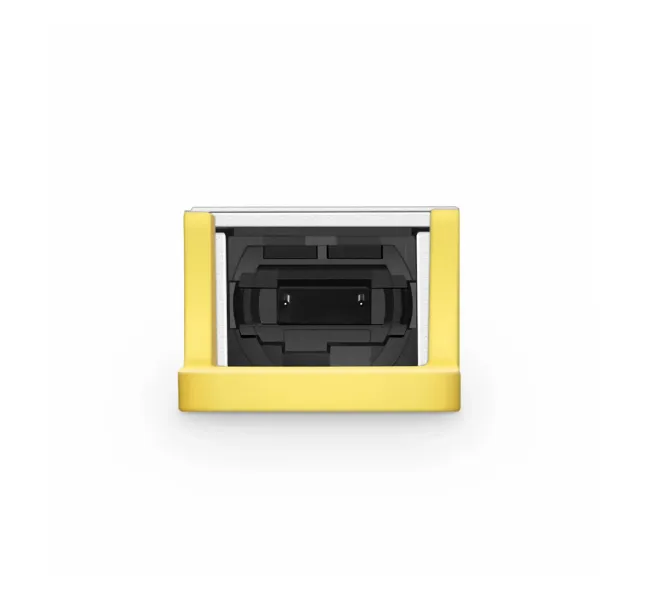
Using a hot-pluggable, finned-top OSFP form factor and a single MPO-16/APC optical interface, the transceiver supports transmission distances up to 100 m over OM4 multimode fiber. Its eight-lane VCSEL-based optical architecture provides a cost-effective, low-latency solution for short-reach connections within data centers, AI clusters, and HPC networks.
Key Features
- Hot-pluggable, finned-top OSFP form factor
- 800 Gigabit Ethernet aggregate data rate
- Eight electrical and optical lanes operating at up to 106.25 Gb/s per lane
- 53.125 GBd PAM4 signaling per lane
- Eight parallel optical transmit and receive channels
- Nominal 850 nm operating wavelength
- Eight high-performance VCSEL transmitters
- Eight high-sensitivity PIN photodiode receivers
- Single MPO-16/APC optical interface
- 8-degree angled physical contact optical connector
- Up to 100 m transmission over OM4 multimode fiber
- IEEE 802.3db alignment
- IEEE P802.3ck/D3.0 electrical interface alignment
- OSFP MSA Revision 5.0 compliant
- CMIS Revision 5.2 compliant
- Integrated digital diagnostic monitoring
- Two-wire I²C management interface
- Single 3.3 V power supply
- Power dissipation below 16 W
- Operating case temperature: 25°C to +70°C
- Storage temperature: −40°C to +85°C
- International Class 1 laser safety certified
- RoHS 2.0 compliant
800G OSFP SR8 Optical Transceiver
The EN-OSFP800-SR8-M16 is an 800GbE OSFP optical transceiver designed for parallel multimode-fiber connections up to 100 m.
The module converts eight electrical PAM4 input lanes, each operating at up to 106.25 Gb/s, into eight parallel optical signals in the 850 nm wavelength band. Each optical signal is transmitted over a separate multimode fiber. On the receiver side, eight parallel optical inputs are detected by PIN photodiodes and converted back into eight PAM4 electrical output lanes.
Unlike FR4 and LR4 transceivers, the EN-OSFP800-SR8-M16 does not wavelength-multiplex multiple optical channels onto duplex fiber pairs. It uses eight transmit fibers and eight receive fibers through a single MPO-16/APC optical interface.
| Parameter | Specification | Parameter | Specification |
|---|---|---|---|
| Part Number | EN-OSFP800-SR8-M16 | Product Type | 800GBASE-SR8 optical transceiver |
| Form Factor | Hot-pluggable, finned-top OSFP | Host Connector | 60-position OSFP host interface |
| Ethernet Data Rate | 800GbE | Lane Configuration | Eight electrical lanes and eight optical lanes in each direction |
| Per-Lane Data Rate | Up to 106.25 Gb/s PAM4 | Signaling Rate | 53.125 GBd per lane, ±100 ppm |
| Modulation | PAM4 | Optical Architecture | Eight parallel optical channels with no wavelength multiplexing |
| Standards Compliance | IEEE 802.3db, IEEE P802.3ck/D3.0, OSFP MSA Revision 5.0 and CMIS Revision 5.2 | Application | 800GBASE-SR8 Ethernet |
| Nominal Wavelength | 850 nm | Wavelength Range | 844 to 868 nm |
| Transmitter Type | Eight VCSEL transmitters | Detector Type | Eight PIN photodiode receivers |
| Optical Connector | Single MPO-16/APC receptacle | Connector Polish | 8-degree angled physical contact |
| Fiber Type | Parallel OM4 multimode fiber | Fiber Count | 16 fibers: eight transmit and eight receive |
| Maximum Reach | Up to 100 m over OM4 MMF | Link Configuration | Point-to-point parallel optical connection |
| Average Transmit Power | −4.6 to +4.0 dBm per lane | Transmitter OMAouter | −2.6 to +3.5 dBm per lane |
| Maximum TDECQ | 4.4 dB per lane | Extinction Ratio | Minimum 2.5 dB |
| RMS Spectral Width | Maximum 0.6 nm | Transmitter Excursion | Maximum 2.3 dB |
| Transmitter Transition Time | Maximum 17 ps | Optical Return-Loss Tolerance | 14 dB |
| Off Transmitter Power | Maximum −30 dBm per lane | Relative Intensity Noise | Maximum −132 dB/Hz |
| Average Receive Power | −6.4 to +4.0 dBm per lane | Maximum Receive OMAouter | +3.5 dBm per lane |
| Receiver Sensitivity | −4.6 dBm OMAouter per lane | Stressed Receiver Sensitivity | −2.0 dBm OMAouter per lane |
| Receiver Damage Threshold | +5.0 dBm per lane | Receiver Reflectance | Maximum −15 dB |
| Approximate Average-Power Budget | Approximately 1.8 dB per lane, calculated from minimum average transmit and receive limits | Approximate OMA Budget | Approximately 2.0 dB per lane, calculated from OMA and sensitivity limits |
| Sensitivity Test BER | 2.4 × 10⁻⁴ | FEC | Not explicitly specified in the module datasheet; configure according to the host platform |
| Breakout Capability | Not explicitly specified in the module datasheet; platform-dependent | Breakout Cabling | Verify against the host port mode, module firmware, connector polarity, and supported breakout configuration |
| Management Interface | Two-wire I²C interface | Management Standard | CMIS Revision 5.2 |
| Digital Diagnostics | Integrated DDM/DOM functionality | I²C Clock Frequency | 100 to 1000 kHz |
| Power Supply | 3.3 V nominal | Supply Range | 3.135 to 3.465 V |
| Power Dissipation | Less than 16 W | Operating Temperature | 25°C to +70°C |
| Storage Temperature | −40°C to +85°C | Relative Humidity | 5% to 85% |
| Minimum Fiber Bend Radius | 6 cm | Laser Safety | International Class 1 laser product |
| Environmental Compliance | RoHS 2.0 | Recommended Cable | 16-fiber OM4 MMF cable with MPO-16/APC connectors |
| Primary Applications | Data centers, AI fabrics, HPC networks, cloud infrastructure, and switch or router interconnects | Cooling Configuration | Integrated finned-top OSFP heat sink |
Connectivity examples

800G to 800G Direct Connectivity

800G to 2x 400GE Breakout Connectivity
Selection Guide
Selecting the right 800G transceiver depends on the host form factor, distance, installed fiber, connector type, thermal capacity, and required port configuration.
| Selection Criteria | Option | Recommended Transceiver | Fiber / Connector | Typical Use Case |
|---|---|---|---|---|
| Host Form Factor | OSFP | EN-OSFP800-SR8-M16, OSFP VR8, DR8, 2×FR4, 2×LR4 or coherent OSFP | OSFP host interface with integrated or riding heat-sink support | High-density switches, AI fabrics, HPC systems and cloud platforms |
| Host Form Factor | QSFP-DD800 | QSFP-DD800 SR8, DR8, 2×FR4, 2×LR4 or coherent optics | QSFP-DD800 host interface | Platforms designed specifically for QSFP-DD800 modules |
| Distance | Up to approximately 50 m | 800GBASE-VR8 or selected 2×400G SR4 modules | Parallel MMF; MPO-16/APC or dual MPO-12/APC | In-rack, adjacent-rack and short-row connections |
| Distance | Up to 100 m | 800GBASE-SR8 | OM4 MMF; single MPO-16/APC | AI clusters, HPC fabrics, leaf-spine and short-reach switch interconnects |
| Distance | Up to 500 m | 800GBASE-DR8 or 2×400GBASE-DR4 | Parallel OS2 SMF; MPO-16/APC or dual MPO-12/APC | Data-center spine links, aggregation and high-density interconnects |
| Distance | Up to 2 km | 800G 2×400GBASE-FR4 or selected DR8-2 implementations | Duplex or parallel SMF; dual duplex LC, CS or MPO depending on module | Large data centers, campus aggregation and short-reach DCI |
| Distance | Up to 10 km | 800G 2×400GBASE-LR4 | Single-mode fiber; dual duplex LC or dual CS | Campus, inter-building and metro-access connections |
| Distance | Up to 120 km | 800ZR coherent OSFP, with an appropriate amplified DWDM system | Duplex SMF LC; tunable coherent DWDM | Data-center interconnect and metro transport |
| Distance | Regional or long haul | 800G ZR+ coherent OSFP with a compatible line system | Duplex SMF LC; amplified DWDM | Metro, regional and long-haul transport |
| Fiber Type | OM4 multimode fiber | OSFP800-SR8 | MPO-16/APC | Short-reach, low-latency data-center connectivity |
| Fiber Type | Parallel single-mode OS2 | DR8, DR8-2 or 2×DR4 | MPO-16/APC or dual MPO-12/APC | 500 m to 2 km parallel-fiber links |
| Fiber Type | Duplex single-mode OS2 | 2×FR4, 2×LR4, ZR or ZR+ | Dual duplex LC, dual CS or duplex LC depending on module | Campus, DCI, metro and transport applications |
| Connector Type | MPO-16/APC | OSFP800-SR8, selected VR8 and DR8 modules | Sixteen parallel fibers | Direct 800G links using eight transmit and eight receive lanes |
| Connector Type | Dual MPO-12/APC | Selected 2×SR4, 2×VR4 and 2×DR4 OSFP modules | Two independent eight-fiber optical interfaces | Dual-400G connectivity and modular cabling |
| Connector Type | Dual Duplex LC | 2×FR4 or 2×LR4 | Two duplex SMF pairs | Two 400G WDM optical connections |
| Connector Type | Dual CS | Selected 2×FR4 or 2×LR4 modules | Two compact duplex SMF connections | High-density WDM connectivity |
| Optical Technology | 8×100G PAM4 parallel multimode optics | SR8 and VR8 | Parallel MMF with MPO interface | Cost-effective, low-latency short-reach links |
| Optical Technology | 8×100G PAM4 parallel single-mode optics | DR8 and DR8-2 | Parallel SMF with MPO interface | Medium-reach data-center connections |
| Optical Technology | Dual 400G WDM engines | 2×FR4 or 2×LR4 | Dual duplex LC or dual CS | Reuse of duplex-fiber infrastructure |
| Optical Technology | Coherent DWDM | 800ZR and 800G ZR+ | Duplex SMF LC with compatible DWDM system | DCI, metro, regional and long-haul transport |
| Breakout Capability | 800G to 2×400G | Selected SR8, VR8, DR8 and dual-engine OSFP modules | MPO or dual optical connectors depending on module | Connecting one OSFP port to two 400G endpoints |
| Breakout Capability | 800G to 4×200G | Selected parallel-optics modules and host platforms | MPO breakout assembly | High-density NIC, DPU and accelerator connectivity |
| Breakout Capability | 800G to 8×100G | Selected eight-lane OSFP modules and host platforms | MPO-16 breakout assembly | Connecting one 800G port to eight 100G endpoints |
| Power and Thermal | Less than 16 W | OSFP800-SR8-M16 | OSFP cage must support the module’s finned-top cooling configuration | High-density short-reach data-center deployments |
| Power and Thermal | Higher thermal budget | Long-reach WDM and coherent OSFP optics | Platform-specific power and cooling | Metro, DCI and extended-reach applications |
Applications
Deployment scenarios for this module
Data Center & Enterprise Networks
High-speed connectivity for leaf-spine architectures, server aggregation, and backbone upgrades supporting growing east-west traffic.
Telecom & Service Provider Transport
Robust optical connectivity for aggregation, metro, and long-haul transport across carrier and service provider networks.
Cloud, AI & Hyperscale Infrastructure
Reliable, low-latency links designed for high-performance computing, AI workloads, and scalable cloud environments.
Quality Certification
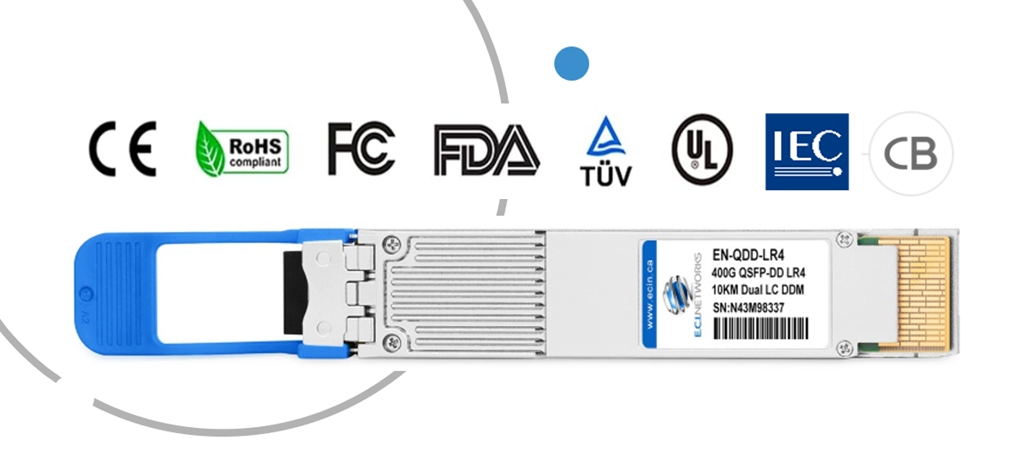
At E.C.I. NETWORKS, all our optical transceivers are CE, FCC, RoHS, and FDA laser compliant, meeting global standards for safety, environmental responsibility, and electromagnetic performance.
Key Certifications
Emissions and immunity compliance for IT and multimedia equipment.
Verified as unintentional radiators with SDoC available.
Safety-certified and laser-classified (Class 1).
U.S. laser safety regulations.
Free from hazardous substances and environmentally responsible.
Available on selected models per regional or customer needs.
Compliance Standards
These certifications ensure our transceivers are safe, interoperable, and built to meet the highest global compliance standards across data center, telecom, and enterprise environments.
Conflict-Free Sourcing
We comply with the SEC Conflict Minerals Rule, supporting ethical sourcing practices for minerals like tantalum, tin, tungsten, and gold.
Quality Certification
At E.C.I. NETWORKS, all our optical transceivers are CE, FCC, RoHS, and FDA laser compliant, meeting global standards for safety, environmental responsibility, and electromagnetic performance.
Key Certifications
Emissions and immunity compliance for IT and multimedia equipment.
Verified as unintentional radiators with SDoC available.
Safety-certified and laser-classified (Class 1).
U.S. laser safety regulations.
Free from hazardous substances and environmentally responsible.
Available on selected models per regional or customer needs.
Compliance Standards
These certifications ensure our transceivers are safe, interoperable, and built to meet the highest global compliance standards across data center, telecom, and enterprise environments.
Conflict-Free Sourcing
We comply with the SEC Conflict Minerals Rule, supporting ethical sourcing practices for minerals like tantalum, tin, tungsten, and gold.
Performance & Reliability
We ensure our optical transceivers deliver exceptional performance and long-term reliability through rigorous testing on industry-leading equipment.
Power & Wavelength Testing
We verify signal strength and wavelength stability to ensure seamless decoding and consistent transmission across the optical path.

Traffic Testing
All transceivers undergo bit error rate (BER) and packet loss testing to guarantee zero data loss and full compliance with Ethernet and Fiber Channel standards.
Optical Performance Validation
Our modules are evaluated for signal integrity, eye diagram clarity, and BER, ensuring stable, high-quality optical transmission in all operating conditions.

End Face Inspection
Each module's fiber interface is inspected and cleaned to eliminate contamination and physical defects - a critical step for optimal signal performance and long service life.
Warranty & Compatibility
Optical Transceivers (1G–400G): Lifetime (5 Years)

Zero Risk
Using our transceivers does not void the warranty of your network equipment. Global OEM policies and consumer protection laws (Magnuson-Moss Warranty Act) prevent manufacturers from denying support based solely on the use of third-party components.

Guaranteed Compatibility
Our modules are coded and tested for seamless operation across major platforms including Cisco, Arista, Juniper, HPE, Nvidia, Huawei, and more. This rigorous validation ensures plug-and-play reliability and full compliance with OEM specifications.

Technical Support & RMA
Have an issue? We provide full technical support and hassle-free RMA on all eligible transceivers. Our team is ready to help with any technical questions about compatibility or deployment. contact our technical support: support@ecin.ca
Q&A
Commonly asked questions
No. Under the Magnuson-Moss Warranty Act and similar global consumer protection laws, OEMs cannot void your equipment warranty simply because you use a third-party transceiver. Your equipment warranty remains intact.
Yes. Our modules can be coded for major OEM platforms (Cisco, Juniper, Arista, Nvidia, etc.) and support open networking environments including SONiC.
A compatible generic version can be provided and coded before delivery.
Common 800G OSFP transceiver types include SR8 for short-reach multimode-fiber links up to 100 m, DR8 for parallel single-mode-fiber links up to 500 m, 2×400G FR4 for single-mode links up to 2 km, and 2×400G LR4 for single-mode links up to 10 km. Coherent 800ZR and ZR+ optics are used for longer data-center interconnect, metro, and transport applications. The OSFP800-SR8-M16 specifically uses eight parallel 100G PAM4 optical lanes, an MPO-16/APC connector, and OM4 multimode fiber for distances up to 100 m.
Choose the transceiver according to the required distance and installed fiber infrastructure. SR8 is best for short data-center links up to 100 m and uses parallel OM4 multimode fiber with an MPO-16 connector. DR8 supports up to 500 m over parallel single-mode fiber and is well suited to leaf-spine links and breakout applications. 2×FR4 supports up to 2 km over two duplex single-mode connections, making it suitable for large data centers and short-reach DCI. 2×LR4 extends the distance to 10 km over two duplex single-mode connections for campus, inter-building, and metro-access links. Always verify the host platform’s OSFP compatibility, connector type, breakout support, FEC configuration, power requirements, and cooling capacity.
Yes. Our modules are coded for the specific platform you select at purchase. They are recognized natively by the switch OS without any additional configuration or commands.
No, E.C.I. NETWORKS 400G transceivers are designed to meet applicable IEEE and MSA specifications, deliver the required 400G data rate and optical reach for their optic class, and support standards-based monitoring such as DDM/DOM. Actual link performance depends on choosing the right 400G type, such as DR4, FR4, LR4, SR8, or ZR/ZR+, and matching it to the correct cabling, optical budget, switch compatibility, and thermal environment.
Yes. We offer full support, RMA service, and warranty coverage on all modules.
Resources
Downloads and documentation