Why Network Visibility Is Critical for Managing Modern, High-Performance Data Centers
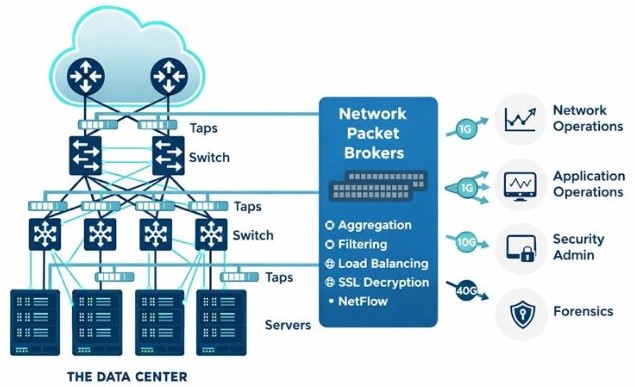
Modern data centers have evolved far beyond static, predictable environments. Today’s infrastructures are highly dynamic, software-defined, and built to support cloud-native applications, AI workloads, 5G traffic, and massive east-west data flows. While performance expectations continue to rise, operational complexity has increased just as rapidly.
In this context, network visibility is no longer optional. It is foundational. Without deep, real-time insight into network traffic and behavior, organizations are effectively operating blind, risking performance degradation, security gaps, and prolonged outages.
The Growing Complexity of High-Performance Data Centers
Several trends have reshaped the data center landscape:
- East-west traffic dominance driven by microservices and distributed applications
- Overlay networks such as VXLAN and Geneve abstracting the physical infrastructure
- Multi-cloud and hybrid deployments spanning on-prem, public cloud, and edge
- Higher link speeds (100G, 400G, and beyond) with dense, high-throughput fabrics
- Strict SLAs for latency-sensitive applications like financial trading, telecom, and AI inference
While these innovations improve scalability and agility, they also obscure traditional troubleshooting methods. Port mirroring alone is insufficient, and relying solely on device counters or sampled telemetry leaves critical blind spots.
What Do We Mean by Network Visibility?
True network visibility goes beyond basic monitoring. It encompasses the ability to:
- See all traffic, not just samples
- Access real packets and metadata in real time
- Understand who is talking to whom, how, and why
- Correlate network behavior with application performance and security events
This level of insight allows teams to move from reactive firefighting to proactive operations.
Why Network Visibility Is Critical
Faster and More Accurate Troubleshooting
When issues arise, from packet loss and latency spikes to intermittent application failures, mean time to resolution (MTTR) becomes critical. Without packet-level visibility, teams are forced to guess, escalating issues across silos.
With full visibility:
- Root cause analysis is data-driven, not assumption-based
- Problems can be isolated to network, application, or infrastructure layers quickly
- Finger-pointing between teams is dramatically reduced
Performance Optimization at Scale
High-performance data centers must operate close to their limits. Visibility enables:
- Identification of congestion points and microbursts
- Validation of QoS, load balancing, and ECMP behavior
- Verification of overlay encapsulation and decapsulation performance
This insight is essential for maintaining predictable performance as traffic volumes and speeds increase.
Security and Threat Detection
Encrypted traffic, lateral movement, and east-west communication make modern attacks harder to detect. Network visibility provides:
- Behavioral baselining to detect anomalies
- Packet and metadata feeds for NDR, IDS, and SIEM platforms
- Evidence for forensic analysis during and after incidents
Security tools are only as effective as the data they receive, and the network is the richest source of truth.
Validation of Automation and Software-Defined Networks
Automation and SDN reduce manual effort, but they also amplify errors when misconfigurations occur. Visibility ensures that:
- Intended policies match actual traffic behavior
- Changes introduced by automation do not create unintended side effects
- Network state can be verified continuously, not just assumed
This is especially critical in environments running SONiC, EVPN-VXLAN, or programmable data planes.
Supporting Business-Critical SLAs
Downtime and performance degradation directly impact revenue and reputation. Network visibility helps organizations:
- Proactively detect issues before users are affected
- Provide objective data for SLA reporting and compliance
- Confidently support mission-critical workloads
The Role of Modern Visibility Architectures
Traditional SPAN ports and ad-hoc monitoring tools cannot keep pace with modern data center demands. Leading organizations are adopting architectures built around:
- Packet brokers to aggregate, filter, and distribute traffic efficiently
- Open networking platforms for flexibility and cost control
- High-speed capture and metadata extraction at scale
- Integration with analytics, NDR, and performance tools
This approach ensures that visibility scales alongside network performance, rather than becoming a bottleneck.
Conclusion
As data centers continue to evolve, network visibility is the foundation that enables performance, reliability, and security. It transforms the network from a black box into a strategic asset, one that empowers operations teams, enhances security posture, and ensures business continuity.
In modern, high-performance environments, you cannot manage what you cannot see. Network visibility is no longer a “nice to have”, it is mission-critical.
Build End-to-End Visibility for High-Speed Data Centers
Work with E.C.I. NETWORKS to design a scalable visibility architecture for performance, security, and operational confidence.